Monday, February 12, 2018

PyeongChang 2018 - Day 1 (February 10th) Gangneung

Sorry that I'm already 3 days behind, but I hope to catch up a little in the next couple days.

Today, we are off to speed skating for the women's 3,000 meter race. We have a little breakfast (toast, yogurt, fuji apple and green tea) with Sunny before she heads off to her cafe. I work on the blog a little (too little - I know) and then we head off toward the train station to find something to eat. We aren't sure about the bus schedule on Saturdays, but there are people waiting so we decide to stop and see if a bus shows up. At the stop, we meet a woman from France that is staying in the same apartment complex and is a member of the same Olympic pin club that I belong to. She is headed to the Coke pin trading tent and is obviously a lot more serious about this than I am because she's nearly filled up her backpack with pins.

The bus does show up (saving us a 40 minute walk!) and deposits us at the train station. There is a performance of some kind going on:


It appears that they are having these performances 4 times per day. Nearby are some people dressed in squid outfits:


I don't quite get what this is all about, but it is entertaining and I appreciate that they took the time to stand out in the cold to do it.

Across from the train station are two tents that have a sign "Taste of Local Food". Hmm, worth a try. Inside are tables where you can stand and eat, surrounded by a variety of serving stations. Here are two women cooking what look like vegetable filled crepes:


Unlike most of what we've seen so far, there are a few signs in English indicating what the food is. We share an order of sweet and sour fried chicken "nuggets" and a couple ears of broiled corn coated with some sort of powdery seasoning. Yum!

Feeling somewhat warmer, we head off to the Gangneung Olympic Park located about 2 km (1.2 miles) north of the train station. For some reason, the only shuttle buses going this way are for elderly and disabled people so we walk. Shortly after, we come to a nice sign:


To the left of this sign is a monster hill (steep enough to be a cat 4 or cat 3 at the Tour de France). After a lot of huffing and puffing, we get to the top and have an almost equally long descent before we get to the area where the spectator buses drop off and pick up. Beyond is the security checkpoint. There, I ran into a problem with my camera. Before we left California, I checked on the list of prohibited items and found that they had banned tripods and monopods in addition to prohibiting all photography for professional/commercial purposes. Fair enough, but sometime between then and when we arrived in Gangneung, the decision had been made to ban all camera lenses longer than 300 mm. I had seen a sign in Jinbu about this so knew it was a problem, but I wanted some nice close-up pictures so I decided to see how firm this ban was, especially since I had brought the same lens to ski jumping without a problem. Sure enough, they asked to look in my bag and the two security guys at our X-ray scanner started talking to eat other in Korean. They indicated to me that it was prohibited. I responded that this was the only lens that I had on my camera and that I did not want to lose my camera and lens. They conferred for a couple of minutes and then one said that they will call a supervisor. After 5 minutes or so a young woman approaches and in very good English tells me about the ban on long lenses. I explained that there was no way that I would be able to produce commercial quality pictures from my seat in the back of the stadium no matter how long my lens was. Eventually, she decides to let me keep the lens. I hope that I'll produce some nice pictures today, because I'm not sure that I'm willing to try this again.

The gates haven't opened for speed skating so we visit the Olympic superstore. This one is much less crowded and we pick up some more pins and a couple of t-shirts. There are often a number of commercial pavilions in Olympic parks and this one is no exception. There is a long line for the Coke Cola pavilion that we decide not to brave, but we make plans to visit the Samsung pavilion as well as Korea House and Tokyo 2020 House on a later visit.

Speed skating is one of our favorite events, but not so much for the sport. We are in it for the Dutch fans:


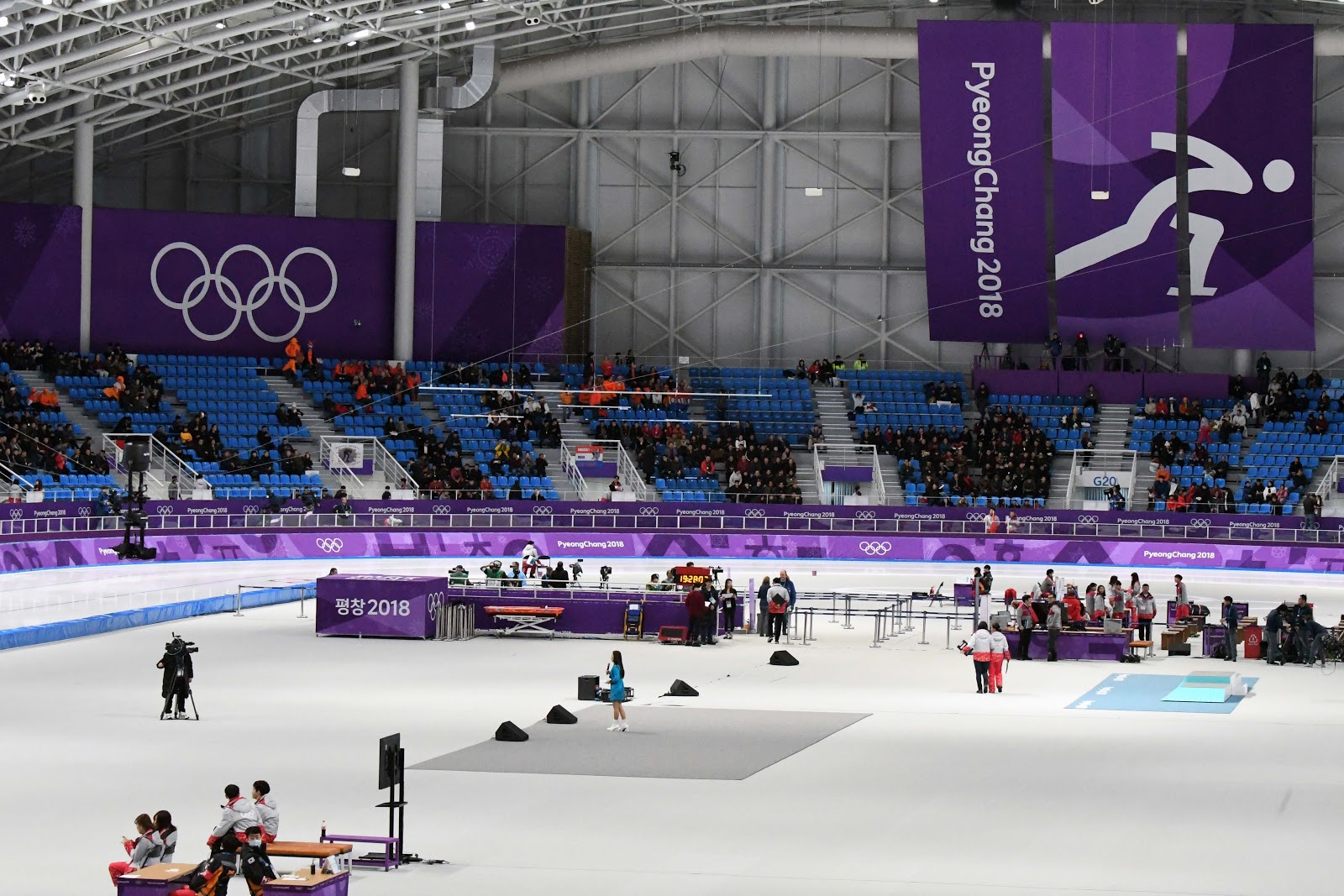
They are so passionate about this sport that it is just a great atmosphere. The venue is beautiful:


There are 12 pairs skating today and they are normally seeded according to their world rankings so that the top skaters go last. The early leader is Japanese skater Sato Ayano (last name first) with a time of 4:04.35 - about 7 seconds off the Olympic record and 10.5 seconds off the World record:


One advantage of a long lens: notice the string around her waist that she uses to keep her inside hand behind her back? I had not seen this before. Speed skaters will do almost anything to decrease drag (skin suits, goggles, etc) so I'm surprised that she would wear something that might increase drag. I guess that the gain of better securing her hand behind her back is worth the drag from the string.

The Dutch fans all got fired up when the first of the three Dutch skaters, Carlijn Achtereekte, skating in the 5th pair against Karolina Bosiak from Poland:


Carlijn was skating in this pair because she's currently ranked 21st in the world at 3,000/5,000 meters and has a personal best of 3:58.63 set at high altitude (where the ice is faster and air resistance lower). Going into this race, she had never won a world cup race, but after a couple laps, it is clear that she is skating a great race. She finishes in a time of 3:59.21 - a spectacular time on what is considered the quite slow ice in Gangneung due to high humidity and being at sea level. She is clearly happy with her time:


But there are still a lot of skaters left. After the first six pairs, they resurface the ice:


Since 2010, these Zambonies have been electric, but unlike the one we remember from Vancouver that dropped hot transmission oil all over the ice surface, these work fine and the ice surface is back in shape in little time.

American speed skating in the longer distances is not in very good shape at this point and only one American, Carlijn Schoutens:


born in the US to Dutch parents, qualified for this event. Carlijn crosses the line in a relatively slow time of 4:15.60. But she is only 23. Speed skaters, like most endurance athletes tend to reach their peak later than other sports, so perhaps we will see her again in four years in Beijing.

In pair 9, we get the woman that the Dutch fans think will win today: 4 time Olympian with 4 gold medals, 3 silver medals and 1 bronze medal, Ireen Wust:


Ireen's specialty is the 1,500 meter so she starts off really fast and by 2,200 meters, she is nearly 1.5 seconds ahead of Achtereekte - yes, I understand the irony of saying that some one is way ahead when you are talking about a period of time slightly longer than it takes to snap your fingers, but that is an indication of how close all of these competitors are. Wust tires badly in the last lap to finish second in 3:59.29, 0.08 seconds behind Achtereekte. 

In the following pair is one of the legends of the sport, 45 year old Claudia Pechstein from Germany who is competing in her 7th Winter Olympics:


seen her on the outside lane. To give you an idea, we saw Claudia set the current Olympic record of 3:57.70 in Salt Lake City 16 years ago! She has 5 gold medals, 2 silver medals and 2 bronze medals. But even though she is still ranked in the top 5 in this event, she has no magic today and finishes in 4:04.49. Nevertheless, she gets a huge cheer, especially from the Dutch fans who know a legend when they see one:

With the top two spots, it is only a question of how many and which kind of medals the Dutch will win. First up is the rising star of the Dutch team, 22 year old Antoinette De Jong skating in the next-to-last pair. She cannot keep up with her two teammates and moves into 3rd place with a 4:00.02.

The only one who can stop a Dutch sweep is another legend, 30 year old Martina Sablikova from the Czech Republic:


skating here on the outer lane. We saw Martina win this event in Vancouver. She has also been the number 1 ranked skater at this distance for 11 of the past 12 years. But by halfway through the race, it is clear that she doesn't have it today. She finishes 4th in a time of 4:00.54. And the Dutch fans go nuts:


The stores in the Olympic Park are shutting down so we head for the exit. Beth is getting tired, but there does not appear to be anywhere we can pick up a taxi. So we decide to try to walk down the city streets below the very steep path back to the train station. Apparently, there are a bunch of people with the same idea because we are following a small crowd of spectators going in the same direction. But the streets are getting narrower and darker. Then we see some of the people who had been in front of us turning around. We see why when we arrive at a dead end. We saw a larger street to our right (farther away from the direction we know we need to go) so we head there. I manage to fire up Google Maps for a few seconds before the cold kills it's battery again to confirm that we can get back to the train station in the direction we are going. But our short cut definitely ends up a long cut so we are very happy when we get back to the train station and catch a taxi back to Sunny's home.

Steps for the day: 8,419 (before the phone died again!)

Sunday, February 11, 2018

PyeongChang 2018 - Day 0 (February 9th) Gangneung and PyeongChang

Today is the Opening Ceremonies! We got home from ski jumping around 1 AM yesterday so we get a very late start. I work on the blog for a while and then we walk down to a convenience store in the apartment cluster (16 14 story apartment buildings - they really believe in high density living in Korea) to see if we can find something to eat. This is tricky because everything is in Korean. Thank God for pictures on food items! We think we've got two instant raman bowls, a couple bottles of water, some chocolate bars and a bag of tortilla chips (talk about cross-cultural).

When we get back to the apartment we discover that our meals are rice bowls, not raman, but the idea is the same - mix the dry components, add boiling water  and wait. This works out quite well. I've got one that has mushrooms and some sort of meat. Beth has a fish-based one. And the tortilla chips are reasonably good imitations of the real thing. Success!

We have train tickets to go to Jinbu at 2:40pm, but after our shuttle bus fiasco of yesterday, we decide to wait until 4:30pm before making our way to the Opening Ceremonies. Since we are wearing enough clothes to keep us reasonably warm at night outdoors, we knew we would cook if we walked back to the train station. We don't know how to call a taxi to the apartment so we elect to try the local bus. There is a bus stop about 800 meters (0.5 miles) from the apartments so we walk over there and wait. I have an app that supposedly will tell me when the bus we want (either 302 or 304) will arrive, but I can't seem to make it work or the buses in Gangneung don't have the transponders that allow it to work. But there are other people waiting so it seems like this will work.

The bus arrives about 10 minutes late and we hop on. It takes only 4 stops before we are at Gangneung station. We head over to information and get two tickets for a train leaving in about 10 minutes.

They announce boarding of our train and we join what looks like a fairly long line to get through security. Unlike yesterday when we basically straight through the metal detector no matter how much metal you were carrying, they are quite meticulous this time, but hey, this is the Olympics. We are used to this stuff.

After the short ride to Jinbu, we enter the station and are greeted with a corridor lined with security personnel. Behind them are perhaps 100 photographers and other assorted media crammed into this little station. We knew that someone important was either on our train or the one that was only about 5 minutes behind it, but did not know who. We find out later that Korean President Moon Jae-In (last name first in Asia), US Vice President Mike Pence and North Korean leader Kim Jong Un's younger sister Kim Yo Jong were all on the train. I understand from talking later to a Korean that we meet that President Moon is in hot water over talk of Korean reunification and is making a show of being "one of the people" by taking public transport instead of motorcades. Needless to say, they were not sitting on the back of the train with us.

Outside the station, a guy smiles and hands me a bag and says welcome to Korea. My initial reaction was confirmed by the handout which shows the steps to salvation. As we queue for the shuttle bus to PyeongChang, we pass a quartet singing gospel music and a minister works his way down the line from passenger to passenger asking us to accept Jesus. Uh oh, we have arrived in the evangelist zone! I understand the need for evangelicals to proselytize and big international events like the Olympics draw them like a magnet. I am sure that I will run into someone in the next 10 days offering to trade what looks like an Olympic pin in exchange for a 5 minute sermon.  Unfortunately, it looks like the Korean form of evangelism is particularly virulent and we are in for more of this than at previous Olympics.

The bus ride to PyeongChang is a little longer than yesterday's trip to Alpensia, but it goes by quickly. Along the way, we pass what looks like the site of the Olympic Downhill course and perhaps the Slalom course as well. The bus lets us off almost directly in front of the Olympic park. We see multiple entry gates, but there is no signage to indicate whether we should enter at a specific gate. We manage to find an English speaking volunteer and find that any gate is okay. Before we enter, we see a group performing down the street:


I guess that people here are just used to the cold, but we can't stay too long in one spot before getting really cold. We go through security and head for the concessions stands. There is a long line for western food, but we head right for the Korean food line which has no line. Despite the menus, not all of the lines have all of the items so Beth gets hot chocolates in one line while I get steamed buns, one filled with red bean paste and the other with a mixture of meat, glass noodles and vegetables, from another line.

There is plenty of time so we go over to the Olympic superstore. It is really crowded so I buy some pins with the mascot Soohorang doing different sports and then we go back outside. Next stop is a visit to the ICT pavilion. ICT stands for information and computer technology and is some sort of joint government/business effort to demonstrate Korean technology. Inside the entry way is a tank full of robot fish that, while a little jerky in their movements, do a reasonable job of mimicking the real thing. The also demonstrate ultrahigh definition TV where you can view an object in pseudo-3D by rotating your viewpoint with respect to the object on the screen. Using this technology, you could, for example, experience the bobsled from the drivers perspective. There are also some virtual reality rides and some examples of augmented reality, but we don't spend much time with those because it is getting time to get to our seats.

Here is the view from our seats:


The stadium, which will be dismantled after the Paralympic closing ceremonies is five sided. Directly across from us is the section where the athletes will sit. The Olympic family (sponsors, head's of state and other dignitaries, sports federation members and national Olympic committee members who are not marching) sit in the section to the left along with TV broadcasters and in the section above the athletes. The rest of the people, who appear to be primarily Korean, are in the remaining three sections. Because the different ticket agents are sold blocks of tickets, we are mostly in a group of Americans, but Beth is sitting next to a Swiss guy (who is living in Hong Kong and is attending his first Olympics) and I've got a couple from Kazahkstan in front of me (who keep waving their flags in front of my camera).

One of the highlights of the opening ceremonies is seeing what is in the bag attached to your chair because it will give you clues about the show. This is our fifth opening ceremonies and our bags have far more in them than we've ever seen. We have:

4 handwarmers
2 bootwarmers
1 seat cushion
1 butt warmer that fits in the seat cushion 
1 blanket
1 hat - ours are blue, but we see other people nearby with yellow, green and red (should be black also, but those are hard to see at night)
1 white rain poncho
1 combination miniature Olympic torch with LED light and pen
1 drum with handle - it takes us some time to figure out that you unscrew the cap at the bottom and pull out the drumstick
1 multilingual instruction sheet with times and description of the meaning of the parts of the show and what we are to do with the torch and drum

Apparently during the test event for the opening ceremonies, several dozen people were treated for hypothermia so the organizers went crazy to make sure that it wouldn't happen again. They also put warming areas downstairs with big butane area heaters in case the cold gets too much for you.

The first hour is the preshow. They start with two guys speaking, respectively, English and Korean. Unfortunately, the guy speaking in English was not using his microphone correctly because the sound kept dropping out. Then a combined group of South and North Korean tae kwon do athletes come out to perform. It was about then that we heard a bunch of cheers and noticed this:


These are the famous North Korean cheerleaders that were brought to the Games to support the 10 athletes that are attending. Their cheers are very coordinated, but I thought that they were often cheering at the wrong times (like not waiting until a break in the tae kwon do performance). In any case, they dominated most of the preshow.

The other important item during the preshow was teaching us how to count down from 10 in Korean. A more or less phonetic version is: Shil, Goo, Pahl, Chil, Yoogh, Oh, Sah, Sahm, Ee, Eel. We are supposed to yell this shortly after the worldwide TV audience tunes in.

While we are waiting for the start of the ceremonies, I notice a group of Russians in a nearby section:


I can't quite make out the letters from our vantage point, but the single letters on their jerseys, but they appear to spell out some sort of protest to the way that the International Olympic Committee (IOC) has dealt with Russian after the investigation into extensive Russian doping at recent Olympics. The Russian government continues to claim that Russian doping is fake news perpetrated by the US. I'm sure that there is some politics involved, but when you find male DNA in the urine sample of a female hockey player, you know that there is a problem somewhere.

We do our Korean countdown and the first part of the artistic program begins. This is mostly Korean mythology and is beautifully done. Here is a picture showing some of the animals of zodiac and other mythical beasts like dragons and phoenixes:


This section appeared to be a little shorter than we are used to, then the Korean flag is brought into the stadium by a combined group of past Korean Olympic medalists and promising youngsters:


The Korean national anthem is played and the flag is raised. The President of Korea declared the PyeongChang Olympic Winter Games open and then the parade of nations begins. As usual, the Greeks come in first:


After that, it was really difficult to figure out who would come next because they are using the phonetic Korean hangul alphabet to decide the order. For example, after Greece comes Ghana, Macedonia, Nigeria, South Africa, Netherlands and Nigeria. But the one that I really wanted to see was Samoa. As you may remember that Tongan tae kwon do athlete Pita Taufatofua walked into the Rio Olympics wearing only sandals and a traditional grass skirt. He made such a splash that he was bombarded with modeling and acting offers, but he had bigger plans. After Rio, he taught himself to cross-country ski, first by dragging wooden boards across the sand dunes of Samoa to build up his muscles and get the feel for the glide that cross-country requires, and later on the snow. He competed in 6 world cup events and qualified for PyeongChang in his last chance. And her he is again carrying the Samoan flag:


This guy is going to be an Olympic legend!

Finally, the team that everyone else was waiting for was the Korean unified team which marched into the arena with two flag bearers under a special unified Korean flag:


It is difficult to overstate exactly how big a deal this is to the Korean people. Feelings about reunification are very complicated. Sunny told me that they've been taught in school from age 7 that people from the North are monsters and I'm sure that the same is true for children in North Korea. But at some level, they all view each other as Koreans. All of the saber rattling between Leader Kim and President Trump has made people in the South very nervous so this unified team carries their hopes that everything will work out.

After the parade of nations, they did something unusual and went back to the artistic portion. I am not sure that I understood the meaning, but it seemed to involve Korea using technology to move into the future. Here is a picture from this section:


The heads of the Organizing Committee (POCOG) and IOC President Thomas Bach address the audience and Bach draws cheers by speaking partly in Korean. At this point, they used to release a bunch of doves, but high definition cameras caught a bunch of them being fried in the Olympic cauldron so now we do the dove of peace a different way:


The Olympic flag is brought into the stadium and an athlete and judge recite the Olympic oaths promising to compete in the spirit of the Olympics. They also added a line about not doping which I can't remember being their previously. Finally, the Olympic flame comes into the stadium. I wish I could show you some pictures, but we appear to be sitting in the only section of the stadium that cannot see the cauldron from our seats. We can just barely see Korean figure skater Yuna Kim (Gold medalist and first Korean to medal in figure skating) in her small skating area at the base of the cauldron.

At this point, we are getting pretty cold and ready to head home, but first, there are a bunch of fireworks:


This vertical firework launcher was pretty cool, but overall, I thought that there were probably a few too many fireworks and our section was engulfed in smoke before they ended. Fortunately, the wind was blowing pretty strongly so it cleared quickly.

With 40,000-50,000 people in the arena, the lines to get out of the stadium are huge and we feel like we are corks being carried along in the current. But eventually we get out and are able to walk without being shoved around too much.

We had previously seen signs directing spectators going to Jinbu so it didn't bother us that there were no English speaking volunteers confirming we were going in the right direction. But when we got to the spectator pickup area, there were no signs - just volunteers telling us to keep going. We see lots of queues for buses, but it is not clear to us which queue we should be in. We finally understand that all of the queues are for buses going to Jinbu, but all of the queues are huge. To make matters worse, after the initial big group of buses departing, there are very few that stop in front of us. We wait about 40 minutes before we are able to get onto a bus. We hear later that the buses stopped completely with more than 1,000 spectators still waiting to get onto a bus - not good.

We arrive back at Jinbu and the station is packed with people trying to get either to Gangneung or to Seoul. We get into the queue to get tickets (the train that we had tickets for left more than an hour earlier), but it is not going quickly. Fortunately, the station master did some outside-the-box thinking and realized at the rate that spectators were getting new tickets, all of the trains would leave with huge numbers of empty seats. He claps his hands and announces that anyone going to Gangneung should follow him and buy tickets on the train. We happily follow him up to the platform.

Our train (leaving at 12:12 - the same one as last night!) is still several minutes away. While we wait, I'm approached by a couple guys from China who want to trade a pin for the official milk supplier for the 2022 Winter Olympics in Beijing for one of my pins. I agree. This draws the attention of a woman wearing a Chinese delegation jacket. She wants a couple of my NBC PyeongChang pins and has some Beijing Olympic mascot sports pins to trade. Deal!

The train finally arrives and we head back to Gangneung. We head immediately to the taxi queue. There are a line of taxis and we move to the left as people in front of us get into taxis. There are only two groups in front of us when we run out of taxis. But when the next taxi arrives, it blows right past us to the original start of the line meaning we are now at the tail of the line instead of the front. It takes us nearly an hour before we get a taxi home. Time 1:30 AM. It has been a good day, but we are really cold and tired.


Steps for the day: 6544 *phone died again - cold weather and batteries don't mix!

Friday, February 9, 2018

PyeongChang 2018 - Day -1 (February 8th) Gangneung and Alpensia

I'm skipping ahead a few days to try to catch up with current time (Feb 9th) and get the Olympic coverage going. I'll get back to the missing days at some point.

We start today by waking up late. Our Airbnb host Sunny had been waiting for us to make breakfast, but she has to get to work at the hospitality cafe she and her daughter were asked to run for the Olympic period. As I understand it, the Gangwon county government has asked shop owners to make over their businesses to make all of the Olympic visitors flooding the area feel welcome. Sunny was chosen because she works as an English tutor and the government wanted some places where English is spoken. We agree to go with Sunny and have breakfast at her cafe. Along the way, she shows us the downtown area and where the market area is.

When we arrive, we see a sign that says English Free Mungju branch cafe. I don't have the heart to tell Sunny that English Free does not mean what she thinks it means. I also think that branch probably means brunch. There are a lot of Koreans who speak some English, but as in our experiences in Japan, they rarely get to try it out with native English speakers so these "near misses" are common.

She needed a little time to get the shop ready so she suggests that we walk down to the corner and take a look at the old building and see what is going on there. The building looks like a miniature version of the palaces we saw in Seoul. In fact, it was the home of the local government which was responsible for keeping the peace, collecting taxes, conducting the census, etc. It is not exactly clear to us what is going on, but here is the sign:


Unfortunately, this is the only English that we see. There appears to be a place where you can see traditional Korean children's games and a place where you can write a wish on a piece of paper and attach it to what looks like a Christmas tree. It looks like the tree will be burned at some point to send all of the wishes to heaven. But what we mostly see is a site that is not quite ready. There are a lot of workers scurrying around trying to get things ready. Some parts of the site appear to have been built just for this event:


We've killed enough time, so we head back to the cafe. Sunny offers us toast, which in this part of Korea means a toasted cheese sandwich, and a couple cups of chamomile tea.  While we are eating, I take a bag from my pocket and beginning sticking Olympic pins on my vest. Along the way, I explain to Sunny that pin trading and collecting is the sport for Olympic spectators. She is intrigued so I give both her and her daughter USA ring pins and a pin of her choice off of my vest. Then it is time to get up and get going.

Gangneung appears to be a pretty big place:


Google maps wants to put everything in Korean which makes it hard to tell where we are going, so I am sort of taking Sunny's route this morning in the opposite direction. We eventually see a sign for Gangneung Station which is where we want to go. Here it is dressed up for the Olympics:


Across the street is what looks like an area set up to showcase the local companies and goods. We wander around a bit and then head back over to the train station to take a taxi back to Sunny's apartment to get ready for tonight's event - men's normal hill ski jumping qualification round. Google says that the apartment is only 2km away and it is fairly close because the taxi only cost 4,000 krw. 

We put on our long underwear and other assorted stuff to keep us from freezing after 4+ hours with temperatures around -7 C (15 F) and head back outside. There is a bus stop not far from Sunny's apartment that is supposed to have buses going back to the train station, but we can't figure out how often they come. So we decide to walk. 2 km aught to take us about 20-25 minutes, but it actually takes more like 40 minutes. We're a little tired and sweaty after our hike, but we make it in time to get on our train to Jinbu; one stop down the line where we are supposed to pick up our shuttle bus to the venue.

We had originally planned to take an early train so that we could walk around, but when we arrive in Jinbu, we are informed by the large group of enthusiastic volunteers that the shuttle buses won't start running until 3 hours before the event which is about 2 hours from now. At least the station is warm and there is part of an Olympic exhibit on Korean history with the Winter Olympics. I say part of an exhibit because here too, workmen are still hanging up items and setting up signage.  There is also a partially complete exhibit of Korean art (vases, sculpture) that is to be part of the cultural Olympiad.

We finally manage to get onto a shuttle bus, which appears to have been a party bus in a previous life based on the colored LED lighting inside. It takes about 20 minutes to get to the Alpensia Olympic Center, which is the venue for ski jumping, aerials, cross-country, biathlon and the three sliding sports: bobsleigh, skeleton and luge.

Even though we've stopped right outside the ski jumping venue, a volunteer asks us to cross the large street that is the main road into Alpensia. We walk uphill for a little while and then are asked to cross the street again to enter the venue from the other side. Strange, but okay. 

Shortly after we enter the venue, we come to a stop in front of what is obviously the security area. It looks like they are also not quite ready as we stood their for a good 20 minutes before continuing on to security. I had been nervous about this because the organizing committee at the last second added camera lenses larger than 300mm to their list of forbidden items and I've got a 70-400mm zoom in my backpack. I'm not sure of how the argument about the impossibility of an old guy with essential tremor producing professional grade photos while handholding a 400mm lens at night is going to go over with a policeman who likely speaks no English, but fortunately, no one asks to look at the lens and we are on to the next stop where we have our tickets scanned.

From there, it is about a 10 minute mostly uphill walk to the venue. Along the way, I am stopped by a Korean guy. It turns out that he is a journalist and wants to ask me a few questions: Where am I from? Is this our first visit to Korea? Do you have a favorite sport or athlete? and then the one that generated his interest, "Can you tell me about these badges that you are wearing?" I tell him that in 2 weeks, pins will be a hot story and that I meet people from all over the world simply be wearing a bunch of pins on my coat and hat.

When we get to the venue itself, a volunteer is scanning the event ticket of the woman in front of us. It fails, presumably because it was already scanned right outside of the security area. We finally manage to make the volunteer understand what is going on and head into the venue looking for food. There are a few people milling around, but not many are being served. We learn from a couple of Americans, that they only have cold drinks and no hot food, but they indicate that there is another concession stand closer to our seats. We head over there. The woman running this stand let us buy two red bean and one BBQ beef steamed buns and watched her spend a good 5 minutes warming them up. I'm thinking to myself that this can't go well once the bulk of the crowd showed up. We also find that the only hot drink she has is coffee. Clearly some bugs need to be worked out of the systems because they are really not ready to be putting on an event here yet. A lot of people over the years have asked me how I tell which are the best Olympics. I usually tell them that a lot of things just don't go well for the first few days when 7 years of planning meet the first day of reality, but the good Olympics are the ones that spot the problems and rapidly fix them. We will see whether POCOG (PyeongChang Olympic Organizing Committee) can rise to the challenge.

The start time on our tickets say 21:30 and it is only 20:00, but shortly after we get there, forerunners begin jumping. We finally figure out that this first round is to set the jumping order for the actual event that begins at 21:30. Here is a picture of the top of the jump:


The normal hill is on the left, the large hill is on the right. We think that the round thing up there may be a restaurant.

The forejumpers help the judges set the start position:


The jumpers sit on that red bar and wait for their coaches to decide when the winds are just right to jump. The start bar can be moved up or down depending on the weather and how far other jumpers are going. When the jumper hits the end of the track, they try to jump up at exactly the right time to maximize lift. Then they put their skies in a V position like this,


trying to mimic an airplane wing as well asusing small hand motions to keep level and pointed at the landing point:


The normal hill has two red lines on the left. The one on top is the K point at 98 meters. Every meter beyond this point is worth 2 points to a jumper and every meter short of this point costs the jumper 2 points. The distance is measured from where the back end of their ski hits the ground. The second red line is the hill size which is in this case 109 meters. If a lot of jumpers are going farther than 109 meters, the judges will move the start position down to slow the jumpers slightly. If they are all landing short of the K point, they'll move the starting position higher up. The hill flattens out below the HS line and landing down there is dangerous as the height you are falling from increases rapidly. The next part of the score is style. Jumpers are trying to land in the telemark style like this jumper is showing - one knee bent and the other leg trailing behind. Finally, there is a compensation score that is based on the wind at takeoff. It is much easier to get lift when the wind is in your face so jumpers that get a strong tailwind gain compensation points while jumpers with a strong headwind lose points.

The event itself lacks much drama because all this is going to do is eliminate 7 jumpers out of the 57 that qualified. The other 50 will go on to the finals on Saturday night. There is a huge range of abilities between the athletes. In the first round, Fatih Arda Ipcioglu from Turkey (and Turkey's first Olympic ski jumper) managed a jump of 77.0 meters worth 21.2 pts while Andreas Wellinger from Germany jumps 112.0 meters worth 87.2 pts. The Americans are not great at ski jumping, but Kevin Bickner manages a jump of 100.5 (68.5 pts) to sit in 14th place. The other Americans are in 37th, 40th and 47th place.

The first jump only sets the start order so the second round represents a fresh start for everyone. Ipcioglu improves in the second round with a jump of 79.0 meters worth, but he still ends up in last place with 68.2 pts. However, he made it to the Olympics and he was selected to carry the Turkish flag at the Opening Ceremonies tomorrow night. Like most of the Olympians, being named an Olympian is the goal and attending the Olympics is the reward. Most of the six other jumpers who fail to qualify (two from Estonia, two from the Czech Republic, one from Kazahkstan and one from Korea) were really young (17 or 18) and were just here to get some Olympic experience.

Along the way, we see some old "friends". One of them is 45 year old Noriaki Kasai from Japan:


Unbelievably, Noriaki-san is competing in his 8th winter Olympics beginning in Albertville in 1992.  (We saw him jump in Nagano, where he won several medals and was the main  TV highlight replay the entire time we were there!)  This is the first time that any athlete in any sport, summer or winter, has qualified for the Olympics this many times. He will be Japan's flag bearer in the Opening Ceremonies and is coming off of winning silver and bronze medals at the Sochi 2014 Olympics. Kasai finishes in 20th place with a jump of 98.0 meters (117.7pts).

Some of the others that have been around a while include 4-time Olympic gold medalist Simon Ammann from Switzerland (competing in his 6th Olympics) and 2-time Olympics silver medalist Janne Ahonen from Finland (competing in his 7th Olympics). But at the end of the day, it is clear that the current powers in ski jumping are Germany and Poland as they go into the finals with 7 jumpers out of the top 10.

At the conclusion of the event, we all try to head out into a fairly narrow walkway and immediately jam up. There is another jam up crossing the street outside the venue and another on the walk back to where we pick up the buses. When we get to the last jam, we understand that the other slow points were because security is stopping people on the walk back to keep the bus pickup area from being jammed up. Once we get down to the bus pickup area, we understand why. Spectators have to cross the main entrance to Alpensia Olympic park in order to get to the boarding area, but there are about a million buses moving along that road so pedestrians can only cross once in a while. Once across the main street, it is a short walk to the bus stop. There are plenty of buses and we manage to get on one quite quickly. But the huge delay in getting to the bus means that we've missed our train to Gangneung. Transportation is the most critical need for spectators and our hope is that this will be one of the areas that POCOG fixes quickly.

We get back to Jinbu after the 20 minute bus ride and immediately head to the information center. This was a reasonably small event so there aren't too many people ahead of us in the line. When we get to the front, we show our PyeongChang 2018 rail passes (which give us free access to trains) and the agent gives us two tickets for a train leaving in 10 minutes (it is now 12:02 AM after the event let out at 10:20 PM). The ride to Gangneung is a quick 15 minutes and it gives us a chance to thaw out.

Our understanding is that the city buses stop running at midnight so we head over to the taxi line. Before we left California, I'd printed out a few "business" cards with Sunny's address printed in Korean. This was handy because our taxi driver did not appear to speak any English. The taxi takes only about 5-10 minutes. Sunny had given us cards giving us access to her apartment building and to her apartment so all we have to do is avoid making too much noise when we come in and take off our boots (like most Asian cultures, shoes are not worn inside the home). It has been a long day!

Steps for the day: 15,373*
* - iPhone died before we got home

Wednesday, February 7, 2018

PyeongChang 2018 - Day -4 (February 5th) Seoul

Welcome to our 2nd day in Seoul! It is already February 7th so I'm already falling behind, but hang in there, once we get to the Olympics, I'll try to post something every day, even if it is shorter.

Today when we went down to the restaurant to eat, we discovered that our initial reaction to the hotel music was correct, this place is stuck in the 1980's and 90's. We been here less that 24 hours and I've already heard 3 or 4 ABBA songs. Breakfast is a sort of UN buffet. In addition to the typical American faire, we also have our choices for Korean, Chinese, Japanese and vaguely European.

Today is history day. We are off to Gyeongbokgung Palace. Gyeongbokgun was built in 1395 and for most of it's history, it was the home of the Joseon Dynasty that ruled Korea for just over 500 years. This palace was mostly burned to the ground during the Japanese invasion in the Imjin War of 1592-5, but was largely rebuilt during the 19th century. Here is part of the palace gate:


The palace and all of what was then Seoul was surrounded by a very big wall. Most of the wall is gone, but here is one of the gates and guardhouses:


The palace has a very strong Forbidden City (Beijing) feel to it. Check out some of these pictures:


This is understandable because of the way that China dealt with nearby countries. In exchange for paying tribute (payments made to China along with things like trade and diplomatic relations), China agreed not to invade. This arrangement kept the Joseon in power for 27 generations of their family. It also resulted in a strong Chinese influence on Korea in the writing system, social structure, arts, etc.

As we were walking around, we noticed a lot of teenage girls wearing elaborate custumes:


The outfits are called hanbok which just means Korean clothing. These outfits date back more than 1,000 years. But it took us a long time to find out why these women are dressing up in these dresses. Apparently, this is one of the latest fads among young people in Korea. Both women and men will dress up in these clothes, take their pictures often at historical sites like this, and then post them on Instagram for their friends to see.

We are getting cold so we stop into the National Folk museum to get warm. In honor of the PyeongChang Olympics, they have a special exhibit on winter showing how the Korean people have traditionally dealt with winter. They showed historical gear for ice fishing, skating and hunting along with what they wore to keep out the cold and crafts that they enjoy in the time before they could begin planting their next crop. Other exhibits gave us some understanding of how hard it was to be a subsistence farmer in such a harsh land.

We are making our way back out of the palace when we hear drums beating. They are changing the guards in the parade grounds just inside the main gate. Here is a picture of the soldiers in their traditional garb:


The guy with the orange and red uniform with pheasant feathers is the battalion commander who is leading the troops coming off duty. Off to the side is a band that is playing suitably military marching music and beating another one of those huge drums like we saw yesterday.

After that, we head to the cafe to get some warm food. Beth has a meal with vegetables and glass noodles and a sort of sweet rice drink and I have bulgogi (a thinly sliced marinated beef dish) with green onions and rice and sparkling water. Feeling much better, we head back outside for a quick walk over to the National Palace Museum.

I had originally thought that this museum would be a sort of National museum, but found that it specialized only on the Joseon Dynasty. It was quite interesting. I learned that one of the reasons that the Joseon ruled for 500 years had partly to do with how they were trained. The Joseon followed Confucianism and one of their critical beliefs were continual improvement. A crown prince was supposed to master skills like calligraphy and poetry and linguistics. In addition, even after becoming King, they were expected to continue to practice to improve their skills  to better lead their people - a far cry from what we currently see in the US government!

A Joseon ruler, even when not present at a social affair or meeting, was represented by this screen called a Irworobongdo sitting behind the throne:


The full moon and red sun represent the concepts of bringing yin and yang into balance, but the meaning of the five peaks and the twin waterfalls have been lost to history. The main idea is that even when he was not present, the Joseon leader was watching over his people.

Since Confucianism includes ancestor worship, each Joseon ruler posed for an official painting. Here is one of them:


On the death of the ruler, his portrait would be installed in a separate nook in the hall of ancestors so that future rulers could come to meditate and seek advice from his ancestors. I'm trying to picture Donald Trump seeing wisdom from George Washington or Thomas Jefferson or.. Barack Obama, but just can't.

We've had enough cold for the day and head back to the hotel. Stay tuned for the next episode.

Steps: 10,751